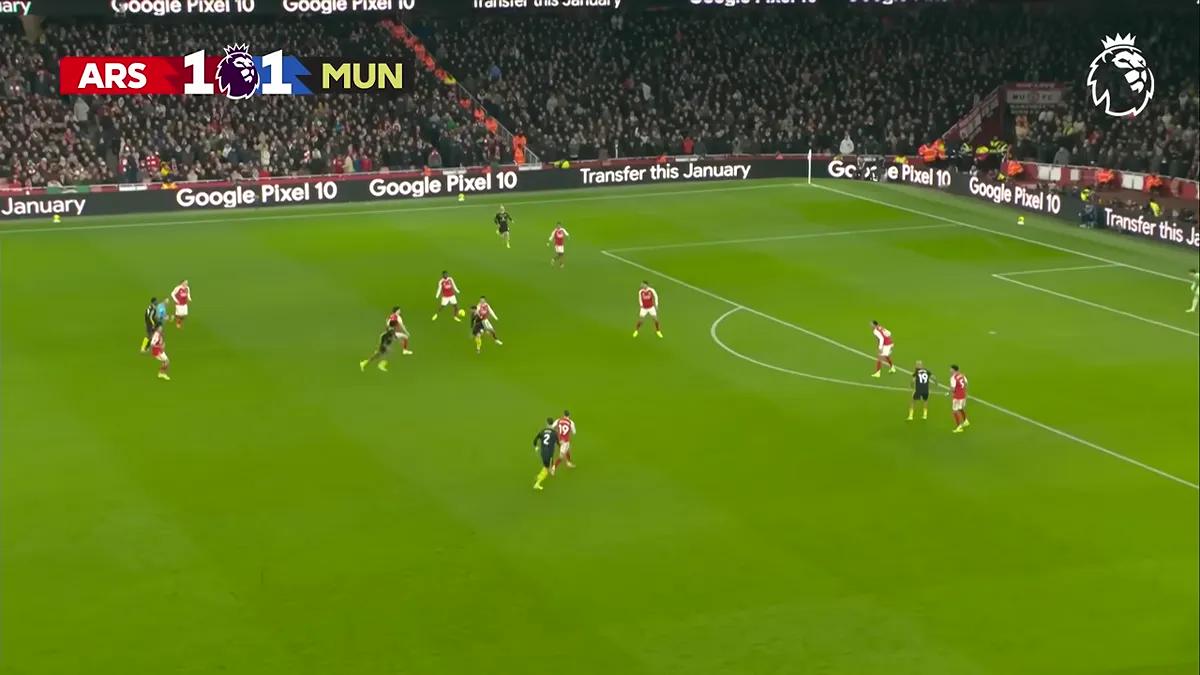
Soccer rules, without the confusion
Three Soccer Rules That Confuse Everyone (And How They Actually Work)
If you’ve ever watched a soccer match and heard the crowd groan at an offside call, wondered why a player just got sent off the field, or lost track of time because the game seemed to go longer than 90 minutes — this guide answers all three. No jargon, no assuming you already know.
We’ll cover:
– Offsides in soccer — what it is, when it applies, and when it doesn’t
– What a red card means — who gets one, what happens next, and how it differs from a yellow
– How long soccer games are — at every level from pro to youth
Offsides in Soccer: The Complete Explanation
What Does Offsides Mean in Soccer?
Offsides (officially spelled “offside” in the Laws of the Game) is called when an attacking player is in an illegal position at the moment their teammate passes the ball forward. The basic concept: you can’t “sneak behind” the defense to wait for a pass and score an easy goal.
The official rule (IFAB Law 11) defines an offside position as: a player who is in the opponents’ half and nearer to the opponents’ goal line than both the ball AND the second-to-last opponent (usually the last outfield defender, since the goalkeeper is typically last).
In plain English: When your teammate kicks the ball forward to you, if you’re ahead of the last defender (not counting the goalkeeper), you’re offside.
Offside Position vs. Offside Offense — This Is What Most People Miss
Here’s the part most new fans don’t realize: being in an offside position is not automatically a foul.
You are only penalized — and the referee stops play — when:
1. You interfere with play (you receive a pass or touch the ball while offside)
2. You interfere with an opponent (you block a goalkeeper’s line of sight, for example)
3. You gain an advantage from being offside (the ball rebounds off a post or goalkeeper to you)
If you drift into an offside position but your team plays the ball to a different player who was onside, no foul. The assistant referee doesn’t flag, play continues.
The timing that trips everyone up: Offside is judged at the exact moment the ball is kicked by your teammate — not when you receive it. You can be in an offside position when the ball is played, sprint back to an onside position, and still be penalized because your position at the moment of the kick is what counts.
When Offsides Cannot Be Called
There are four situations where the offside rule does not apply, no matter where you are on the field:
- You’re in your own half — only the attacking half matters
- You’re level with the second-to-last defender — level counts as onside
- You’re level with or behind the ball — can’t be offside if the ball is further forward than you
- The ball comes from a goal kick, throw-in, or corner kick — these set-piece restarts are offside-exempt
That last one catches a lot of new fans: if a goalkeeper punts the ball and it lands in front of a forward who’s past all defenders, that’s not offside. Corner kicks too — you can stand on the goal line with no defenders around and head it in legally from a corner.
How Is Offsides Judged? VAR and Semi-Automated Offside Technology
Before VAR (Video Assistant Referee), offsides were called by an assistant referee (the person running the sideline with a flag). They had a fraction of a second to freeze the image in their head.
Since the 2022 World Cup, FIFA introduced Semi-Automated Offside Technology (SAOT) — sometimes called “spider-cam offside” — at major tournaments. This system:
– Tracks 29 points on each player’s body at 50 frames per second using 12 dedicated tracking cameras
– Calculates the offside line and each player’s position at the exact millisecond the ball is kicked
– Produces a 3D render the video review team can check in seconds
The system dramatically reduced the time VAR reviews took for offside calls. At the 2026 FIFA World Cup, SAOT was used across all venues, cutting average offside-VAR review times from several minutes down to under 60 seconds.
One important note: The hands and arms are never used to judge offside. Only the head, body, and feet count. A player with their arm extended past the last defender is not offside because of that arm.
Why Does the Offside Rule Exist?
Without the offside rule, attackers would simply stand on the opponent’s goal line and wait for long balls. There’d be no reason to build play from the back, no midfield battles — just a target player camping by the net. Offside forces attacking teams to be creative, time their runs, and build through the field.
Common Offsides Questions Answered
Can you be offside if you don’t touch the ball?
Yes — if you’re in an offside position and you obstruct the goalkeeper’s view or distract a defender to influence the play, you can be penalized even without touching the ball.
Can the goalkeeper be called offside?
No. The goalkeeper is typically the “last” player, so their position sets the offside line. They can move as far up the field as they want without being offside.
What happens after an offside call?
An indirect free kick is given to the defending team from the spot where the offside player was when the ball was played (or where they interfered with play).
Can you be offside on a header off a throw-in?
No. Throw-ins are exempt from the offside rule, so you can receive a throw-in past all defenders legally.
Can you be offside in your own penalty area?
No. You can only be offside in the opponents’ half of the field.
What Does a Red Card Mean in Soccer?
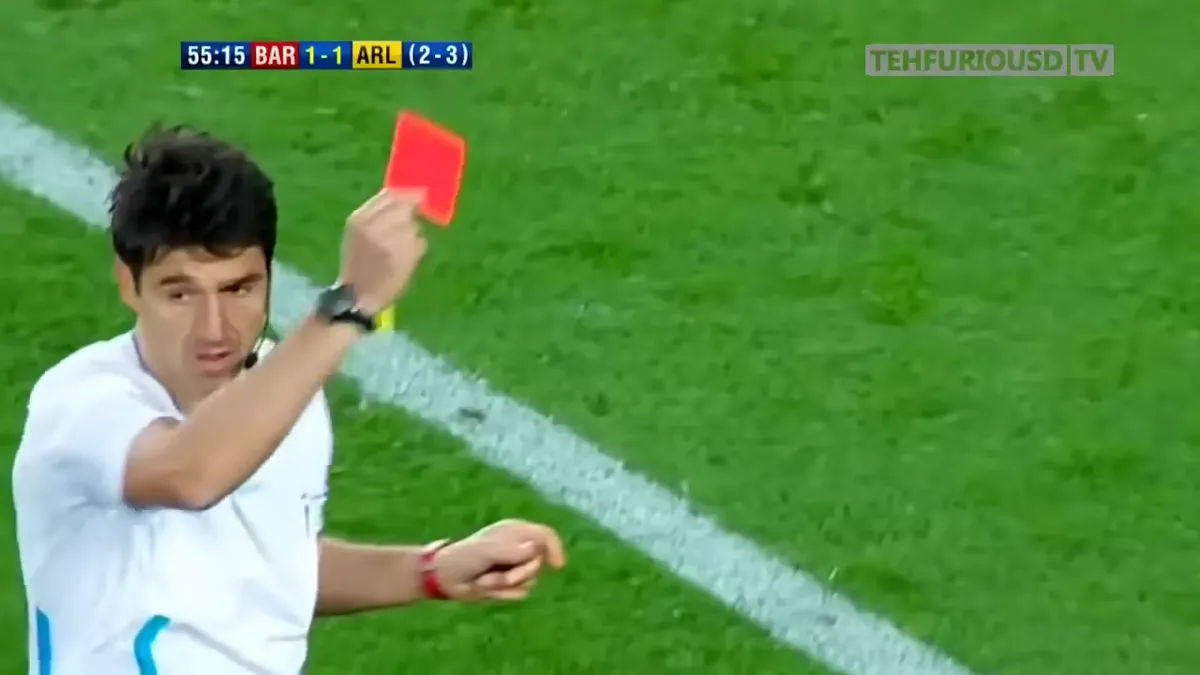
The Short Answer
A red card is a sending-off. The moment a referee shows a player a red card, that player must immediately leave the field of play and cannot return. Crucially, their team cannot bring on a substitute to replace them — they must finish the game with one fewer player.
If a team has 11 players and one gets a red card, they play with 10. If two players get red-carded in the same match, they play with 9.
Straight Red vs. Second Yellow
There are two ways to receive a red card:
1. Straight red card — for serious offenses, given without a prior yellow card. You’re gone immediately.
2. Second yellow card (= red) — a player who already received a yellow card in the same match and earns a second one is automatically shown a red card. This is called being “cautioned twice” or “double-booked.” The referee typically shows the second yellow card first, then the red.
What Offenses Get You a Red Card?
Under IFAB Law 12, a player can be sent off for any of the following:
- Serious foul play — a tackle using excessive force that endangers an opponent’s safety
- Violent conduct — striking, biting, spitting at, or attacking another player, official, or anyone else on or off the field
- Denying an obvious goal-scoring opportunity (DOGSO) — commonly called “denial of an obvious goal” — when a defender intentionally handles the ball or fouls an attacker who would clearly have scored
- Offensive, insulting, or abusive language or gestures — including toward officials, opponents, or spectators
- A second caution (yellow card) in the same match
- Using or attempting to use electronic communication devices (relevant for on-field players)
Important nuance on DOGSO: The “triple punishment” debate has been partially resolved. Under current rules, if a foul inside the penalty area denies an obvious goal but the defender was “attempting to play the ball” (not a deliberate handball), the referee gives a penalty kick but only a yellow card rather than a red — to avoid the harshest double punishment of penalty + red + suspension.
What Happens After a Red Card?
Immediately: The player leaves the field. Their team plays short-handed.
After the match: Suspensions vary by competition. In most professional leagues:
– Straight red card = automatic 3-match ban (can be longer for violent conduct)
– Second yellow = automatic 1-match ban
– The player can typically appeal the decision
Can a coach/manager get a red card? Yes. Managers and technical staff can be sent off for misconduct, at which point they must leave the dugout and technical area. They may be able to watch from elsewhere in the stadium, depending on competition rules.
Can a red card be overturned by VAR? Yes. VAR can review red cards for cases of “clear and obvious error.” A straight red card given for DOGSO or serious foul play can be downgraded; conversely, a missed serious foul can be upgraded to a red card after review.
Yellow Card vs. Red Card: Side-by-Side
| Yellow Card | Red Card | |
|---|---|---|
| Meaning | Caution / warning | Sending off |
| Player leaves? | No | Yes, immediately |
| Substitute allowed? | Yes | No |
| Still in the game? | Yes, unless they get a second | No |
| Typical suspension | One match (if accumulated) | 1-3+ matches |
| Given for | Persistent fouling, dissent, time-wasting, simulation, minor DOGSO | Serious foul play, violent conduct, DOGSO, offensive language, second yellow |
How many yellow cards before a red? Two yellow cards in the same match automatically produce a red and a sending-off. Accumulated yellows across multiple matches trigger suspensions (the threshold varies by competition — typically 5 in a tournament, 10-12 in a league season).
When were cards introduced? Referee Ken Aston invented the idea of colored cards after noticing communication problems during 1966 World Cup matches. Red and yellow cards were used officially for the first time at the 1970 FIFA World Cup in Mexico.
How Long Are Soccer Games?
The Standard Length
A professional soccer match is 90 minutes long — two 45-minute halves with a halftime break of up to 15 minutes.
But here’s what trips people up: the clock never stops. Unlike basketball or American football, soccer uses a running clock that doesn’t pause for fouls, injuries, substitutions, or goal celebrations. Instead, the referee adds time at the end of each half to compensate.
What Is Stoppage Time (Added Time / Injury Time)?
At the end of each half, the fourth official (the official standing on the sideline near the coaches’ benches) holds up a board showing the minimum number of minutes to be added. This is called stoppage time, added time, or informally “injury time.”
Stoppage time accounts for:
– Time lost to injuries (and the medical team coming on)
– Substitutions
– Goal celebrations
– VAR reviews
– Time-wasting by players
– Any other delays the referee deemed significant
At the 2022 and 2026 World Cups, FIFA instructed referees to add more stoppage time than was typical in club leagues — matches regularly had 8-12 minutes of added time per half, which surprised many viewers used to 2-4 minutes. This was intentional: FIFA wanted to reduce time-wasting and ensure the full 90 minutes of actual play.
Does the match end exactly when the minimum stoppage time expires? No. The referee can play on at their discretion. If a team attacks dangerously at exactly the 90+8 minute mark, the referee will let the play finish before blowing the whistle. Stoppage time is a minimum, not a maximum.
Total Real-World Time to Watch a Soccer Match
A professional soccer match will typically run 1 hour 45 minutes to 2 hours of real-world viewing time, including:
– 45 minutes of first half
– 5-15 minutes of stoppage time across the match
– 12-15 minutes of halftime
– 45 minutes of second half
Soccer Game Length by Level
| Level | Playing Time | Format | Halftime |
|---|---|---|---|
| Professional (MLS, Premier League, La Liga, etc.) | 90 minutes | Two 45-min halves | Up to 15 min |
| College / NCAA | 90 minutes | Two 45-min halves | 15 min |
| High School (NFHS rules) | 80 minutes | Two 40-min halves | 10 min |
| Youth Under-17 / Under-16 | 80 minutes | Two 40-min halves | Varies |
| Youth Under-14 / Under-13 | 70 minutes | Two 35-min halves | Varies |
| Youth Under-12 / Under-11 | 60 minutes | Two 30-min halves | Varies |
| Youth Under-10 | 50 minutes | Two 25-min halves | Varies |
| Youth Under-8 | 40 minutes | Two 20-min halves | Varies |
Note: Youth ages follow US Youth Soccer / US Soccer Federation recommendations; local leagues may adjust.
What Happens If It’s a Tie?
In league play (MLS, Premier League, La Liga, etc.): The game ends in a draw. Each team earns one point.
In knockout/tournament rounds: A tied score after 90 minutes leads to:
1. Extra time — Two additional 15-minute halves (30 minutes total). If the score is still level after extra time:
2. Penalty shootout — Each team takes 5 penalties alternately from the penalty spot. If still tied after 5 each, it continues in sudden death (one kick at a time, alternating).
The “golden goal” rule (extra time ending immediately on the first goal scored) was used briefly in the 1990s and 2000s but is no longer in use at FIFA tournaments or major leagues.
Quick Reference: Soccer Rules Summary
| Rule | Key Fact |
|---|---|
| Offside | Player must be in opponents’ half AND ahead of second-to-last defender when ball is kicked |
| Offside exceptions | Goal kick, throw-in, corner kick = no offside possible |
| Red card | Sending off — player leaves immediately, no replacement allowed |
| Second yellow | Automatically becomes a red card |
| Game length (pro) | 90 minutes + stoppage time |
| Game length (HS) | 80 minutes (two 40-min halves) |
| Overtime | Extra time (30 min) + penalty shootout, in knockout rounds only |
FAQ — Soccer Rules
What does offsides mean in soccer?
Offsides (officially “offside”) is when an attacking player is nearer to the opponents’ goal than both the ball and the second-to-last defender (usually the last outfield player) at the moment a teammate plays the ball forward to them.
Can you be offside on a corner kick?
No. Corner kicks, goal kicks, and throw-ins are all exempt from the offside rule. You can stand right on the goal line and receive the ball legally from any of these set pieces.
What does a red card mean in soccer?
A red card is a sending-off. The player must immediately leave the field permanently, the team cannot replace them with a substitute, and the player typically receives a multi-match suspension.
Is a second yellow card the same as a red card?
Yes. If a player who already holds a yellow card from earlier in the same match receives a second caution, the referee shows the second yellow and then immediately shows the red, sending the player off.
How long is a soccer game?
90 minutes (two 45-minute halves) plus stoppage time, at the professional and college level. Total real-world viewing time is typically 1:45–2:00.
What is stoppage time in soccer?
Stoppage time (also called added time or injury time) is extra minutes added to each half by the referee to compensate for time lost to injuries, substitutions, VAR reviews, and other delays. The amount is displayed by the fourth official on a numbered board.
Does a red card affect the next game?
Yes. A red card leads to an automatic suspension in most competitions. A straight red card typically carries a 3-match ban; a second yellow (automatic red) typically carries a 1-match ban.
Can a goalkeeper be offside?
No. The goalkeeper is the last player and establishes the offside line. They cannot be in an offside position because they are always the deepest defender.
Why do soccer games go past 90 minutes?
The clock does not stop during play. Instead, stoppage time is added after the 45th and 90th minutes to compensate for delays. Since 2022, referees have been instructed to add more time, meaning professional matches often run to 98-100+ minutes of total play.
Can a coach be sent off in soccer?
Yes. Managers and technical staff can receive a red card for misconduct. They must leave the technical area but may watch from elsewhere in the stadium, depending on competition rules.

